Earthquakes study song
Quick answer
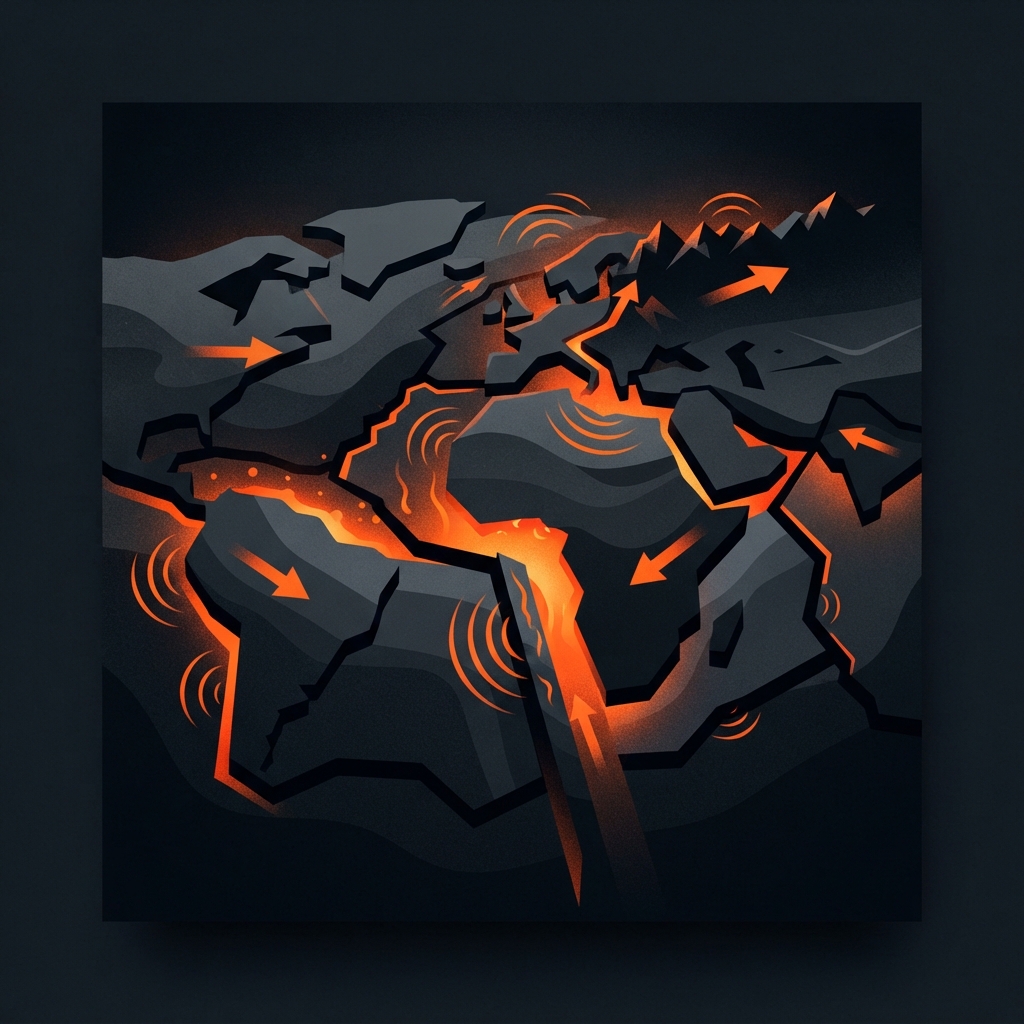
Earthquakes are sudden releases of energy in the crust, mostly along plate boundaries, and they feature in nearly every physical geography syllabus. You need to know the vocabulary, such as focus and epicentre, the types of seismic wave, how magnitude is measured, and why the same size quake can cause very different damage in rich and poor countries.
Exam answers often go wrong by swapping focus and epicentre or by treating the Richter scale as linear. The terms come in tight pairs and sequences, which suits a rhythmic song, and a catchy line for the wave order helps you recall which wave arrives first.
5 facts to know about earthquakes
- 1The focus is the point underground where the earthquake starts, and the epicentre is the point on the surface directly above it.
- 2P waves are the fastest seismic waves and arrive first, and they can travel through solids and liquids.
- 3S waves are slower than P waves and cannot travel through liquids.
- 4The Richter scale is logarithmic, so each whole number increase means ten times larger wave amplitude.
- 5The Pacific Ring of Fire has about 90 percent of the world's earthquakes.